
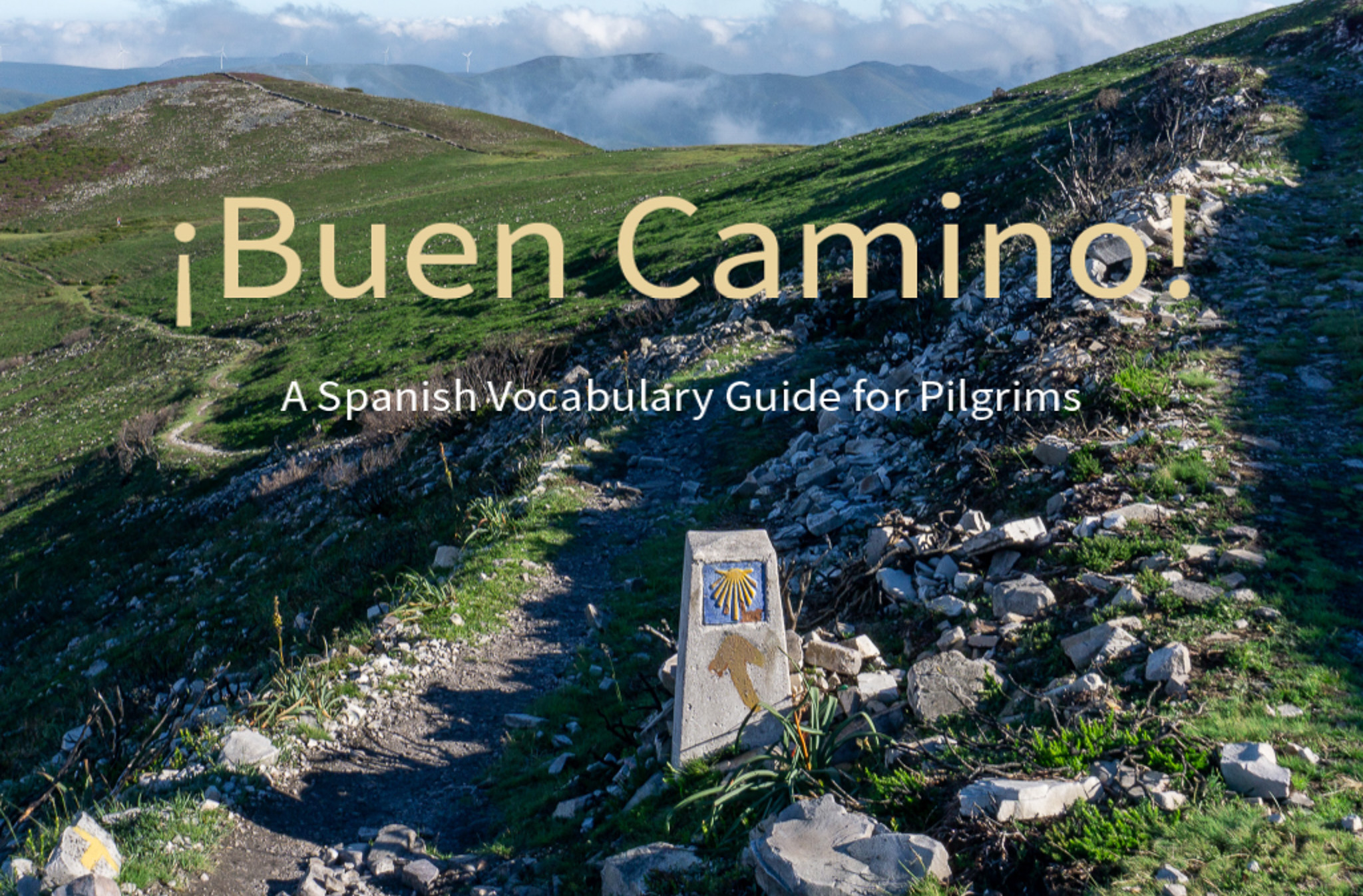
Learning a few simple phrases in the local language can go a long way when traveling abroad. As you walk the Camino de Santiago this is particularly true as you’ll be spending so much time hiking through rural areas.
While embarking on the Camino doesn’t necessarily require fluency in Spanish, having a basic grasp of the language can help turn communication breakdowns into success stories. From ordering a hearty meal at a rustic local tavern to inquiring about the next albergue to rest your weary feet, knowing a few key phrases can make all the difference.
As a university instructor I helped bring students up to basic fluency over the course of a few months. Survival Spanish, however, can be learned even more quickly using the right targeted vocabulary.
In this article, I give you a curated selection of essential Spanish vocabulary tailored explicitly for hikers on the Camino de Santiago. With a focus on the most practical terms and phrases, I hope to empower you to fearlessly navigate the Spanish countryside.
Greetings and Pleasantries
Hola – Hi, hello
¿Que tal? – How’s it going?
Buenos días – Good morning
Buenas tardes – Good afternoon
Buenas noches – Good evening / good night
Gracias – Thank you
De nada – You’re welcome
No hay de que – You’re welcome (nothing to thank me for)
Mucho gusto / un gusto – Nice to meet you
(Ha sido) un placer – It has been a pleasure
Adiós – Goodbye
Chao– Goodbye (slightly less formal)
Hasta luego – See you later
Perdón, perdona – Pardon, excuse me
Sí – Yes. (to save you a future headache: Sí with a tilde means “yes”, si without a tilde means “if”)
No – No
A quick note on articles before diving into vocab:
| Definite Articles | Singular | Plural |
| Masculine | el (the) | los (the) |
| Feminine | la (the) | las (the) |
| Indefinite Articles | Singular | Plural |
| Masculine | un (a/ an) | unos (some, a few) |
| Feminine | una (a / an) | unas (some, a few) |
Camino-Specific Vocabulary
El Camino – The way, the path, the road
Un peregrino/ una peregrina – A male pilgrim, a female pilgrim
¡Buen Camino! – Typical pilgrim salutation. “Have a good pilgrimage!”

Un albergue (pronounced al-bear-gay) – A pilgrim specific hostels
Albergue público – Publicly owned pilgrim hostel (usually the least expensive option)
Albergue privado – Privately owned pilgrim hostel
El menú peregrino – Special combo meal offered to pilgrims at many restaurants
Un sello (pronounced say-yo) – Stamp
El credencial – Pilgrim passport stamp book. This will allow you to stay at official pilgrim hostels and act as proof when you get your “compostela” certificate.
La Compostela – Official certification that you hiked the Camino de Santiago
Una flecha – An arrow (you’ll be following arrows the whole way to Santiago)
Una flecha amarilla – Yellow arrow
Una mochila – Backpack
Un baston / unos bastones – A walking stick / some trekking poles
Maps and Directions

Derecha – Right
Izquierda – Left
Recto – Straight
Al lado de _______ – next to __________
Atras – Back
Detrás de _______ – Behind (something or someone)
Aquí – Here
Allí – There
Allá – (Way) over there
Cerca – Close
Lejos – Far
Un mapa – A map
La ruta – The route
Un guía – A guidebook, a guide
Una calle – A street
Un callejon – An alley
La acera – Sidewalk
Una plaza – A town square
La esquina – The corner
Dar la vuelta – To turn around
A la vuelta de la esquina – Around the corner
El monumento – The monument
El museo – The museum
Una iglesia – A church
El catedral – The cathedral
Clothing and Gear

Las botas – Boots
Las chanclas – Sandals, flip-flops
Los zapatos – Shoes
Los tenis (TEN-ees) – Tennis shoes, running shoes
Los calcetines – Socks
La ropa interior – Underwear
Un sombrero – Brimmed hat
Un gorro – Baseball hat or beanie
Los pantalones – Pants, trousers
Los pantalones cortos – Shorts
La falda – Skirt
Una camisa – (Collared) shirt
Una camiseta – T-shirt
Un suéter – Sweater
Un abrigo – Coat
Un impermeable/ un chubasquero – Raincoat
Un traje de baño / un bañador – Bathing suit, swimsuit
Crema solar / protector solar / bloqueador – sunscreen
Los lentes / las gafas – Glasses
Gafas de sol – Sunglasses
Numbers
1 – uno
2 – dos
3 – tres
4 – cuatro
5 – cinco
6 – seis
7 – siete
8 – ocho
9 – nueve
10 – diez
11 – once
12 – doce
13 – trece
14 – catorce
15 – quince
16 – dieciseis
17 – diecisiete
18 – dieciocho
19 – diecinueve
20 – veinte
21- veintiuno
22 – veintidos
23- veintitrés
24- veinticuatro
25- veinticinco
26- veintiseis
27- veintisiete
28 – veintiocho
29 – veintinueve
After 20, this pattern repeats all the way up to 100.
30 – treinta
40 – cuarenta
50 – cincuenta
60 – sesenta
70 – setenta
80 – ochenta
90 – noventa
100 – cien
At the Albergue (or hostel, hotel, etc.)
La cama – Bed
La litera – Bunk bed
Litera de arriba – Top bunk
Litera de abajo – Bottom bunk
La almohada – Pillow
Las sábanas – Sheets
La manta – Blanket
La cocina – The kitchen
El frigorífico / la refrigeradora – Refrigerator, fridge
La estufa– The stove
El horno– The oven
El microondas – The microwave
La basura – Garbage, trash
Colgar la ropa / tender la ropa – To hang (clothing)
Un tendedero – A clothes hanger (typically a wire loop)
Una pinza, unas pinzas – A clothespin, some clothespins
¿Dónde se puede colgar la ropa? – Where can I hang my clothes?
¿Dónde está la cocina? – Where is the kitchen?
Transportation

Un aeropuerto – An airport
La estación de tren – Train station
La estación de autobuses – Bus station
Un billete/ un boleto – Ticket
La salida – Departure
La llegada – Arrival
Un taxi – Taxi
El coche / carro – Car
El metro – The subway/Metro
¿A qué hora sale/llega el tren/autobús/avión? – What time does the train/bus/plane leave/arrive?
¿Cuánto cuesta un billete a…? – How much is a ticket to…?
Shopping
Una tienda – A shop / store
Un mercado – Market
Ir de compras – To go shopping
Un carrito – Shopping cart
La cesta – Basket
La caja – Cash register
El cajero – Cashier / can also mean ATM
¿Cuánto cuesta…? – How much does … cost?
¿Quieres una bolsa? – Do you want a bag?
¿Algo más? – Anything else? (Note: this is a super common question in almost every store in Spain)
At the Market or Supermarket

El mercado – The market
El supermercado – The supermarket
Las frutas – Fruits
Las verduras – Vegetables
El pan – Bread
La leche – Milk
Los huevos – Eggs
La carne – Meat
El queso – Cheese
El pescado – Fish
El pollo – Chicken
El yogur – Yogurt
In a Restaurant
El desayuno – Breakfast
La comida – Lunch (this is true in Spain, though some countries call lunch ‘el almuerzo’)
La cena – Dinner
El postre – Dessert
El Camarero/ la camarera – Waiter/ waitress
Vegetariano – Vegetarian
Vegano – Vegan
Sin gluten – Gluten free
Menú del día – Lunch special found in most restaurants; typically consisting of two courses, desert and a drink
Una propina – Tip or gratuity
Lleva … ? Does it contain …. ? (This is a good way to ask about meat if you’re a vegetarian, or certain foods you’re allergic to)
¡Que aproveches! – Enjoy your meal!
¡Cóbrame, por favor! – Charge me, please! (asking for the bill)
¡La cuenta, por favor! – Check, please!
Emergencies
¡Ayuda! – Help!
Una urgencia – An emergency
Una ambulancia – Ambulance
El hospital – Hospital
Necesito un médico – I need a doctor
Llame a la policía! – Call the police
Estoy perdido/a – I am lost
Simple Questions
¿Dónde está … ? – Where is … ?
¿Cuándo es… ? – When is …?
¿Por qué… ? – Why… ?
¿Cómo te llamas? – What’s your name?
¿Cómo puedo… ? – How can I… ?
¿Cuánto cuesta… ? How much does … cost?
¿Tienes .. ? – Do you have … ?
¿Puedes ayudarme? – Can you help me?
¿Dónde puedo encontrar… ? – Where can I find … ?
Miscellaneous Useful Phrases
¿Me podrías decir … ? – Could you tell me… ?
¿Hay WIFI aquí? – Is there WIFI here? (WIFI is pronounced wee-fee in Spain)
¿Cual es la contraseña de la WIFI? – What ‘s the password to the WIFI?
Me duelen los pies – My feet hurt
Me duele la espalda – My back hurts
Estoy deshidratado/a – I’m dehidrated
Estoy cansado/a – I’m tired
Tengo una ampolla en el pie – I have a blister on my foot
¿Dónde se puede comprar comida? – Where can I buy food?
¿Hay un restaurante en este pueblo? – Is there a restaurant in this town?
¿Hablas inglés? – Do you speak English?
Final Thoughts
If you are spending a lot of time memorizing questions it’s important to make sure you are ready for the answer! It’s also good to work on your accent, just be sure not to spend too much time on the way you sound before you know enough to understand the responses you get back.
While it’s useful to have a list like this one, you’ll also want to get in enough practice to make the information useful to you. Many people will get flustered when first trying to use a language they have been studying. Getting lots of repetitions in will help you stay relaxed while trying to communicate in Spain.
Using apps like Duolingo, Babble or Italky can provide you with regular practice and can help build up your confidence. Learning a language is easier today than it ever has been with tons of resources and guides available through your phone. If you want to read more on the topic, check out my post on language learning for travel.
Remember that this trek is an adventure and even communication breakdowns are learning experiences. As long as you learn from them, every mistake is just a new data point.
If there are any other crucial words that I missed, drop me a note down in the comments and I’ll either provide it there or add it to the list! I hope this article helps to build your confidence learning language for travel. Buena suerte y Buen Camino (good luck and have a good Camino)!
Leave a Reply