
Olabe to Eskerrika
Distance Covered: 11 miles / 18 Km
This section of the Camino traverses the quaint, rolling landscape between two smaller towns on either side of Guernica, offering a mostly calm day before heading into the largest city on the Camino del Norte. The route also passes through the historically significant town of Guernica, whose name you may recognize from Picasso’s famous painting.
I normally would have stopped to sleep in Guernica, but after hearing rumors from several other pilgrims about it being closed for the season, I figured I would play it safe and stop early the day before. There is also no need to stick to the predetermined distances you may find online, as there are several albergues located in small towns that you walk through each day. Pilgrims may start their trip following the recommended daily distances, but after five or six days of hiking the route becomes much more of a choose-your-own adventure.
If this is the first post you’re reading from this series, take a look at the main page for my Camino hike write-ups and start from the beginning. And in case you have any general questions about the Camino de Santiago pilgrimage, start with my post explaining everything you need to know about the Camino de Santiago.
Starting out on day 6 of my Camino del Norte
Waking up well-rested in Olabe, I drank a quick cup of coffee, filled my hydration bladder and headed out on the trail. It was supposed to get hot today, and I was hoping to cover some mileage before the sun got too high in the sky.
As I made my way up the steep hill out of town and out into the forest, I finally felt like I was adjusting to the rhythm of life as a pilgrim.


The morning was quiet, mainly spent walking on my own and listening to a podcast as I made my way between the small towns. I felt like I was finally starting to get into a groove, growing accustomed to the simple, steady tempo of walk, eat, sleep. There is definitely something mentally relaxing about having very well-established goals in day to day life that lets the mind wander.
Throughout the day, I kept bumping into a group of middle-aged Spanish men that I joked with as we leapfrogged one another. I would pass them, then stop for a coffee or a bite to eat, only to bump into them again an hour or so later, sitting outside of a café or filling their water bottles at a fountain. One of the best parts of the Camino is bumping into people you met a week or two earlier in a random bar in a small town in rural Spain, which is part of what makes this whole hike such a fun experience.
I stopped for a bite to eat and ended up staying at the café a bit longer than I probably should have, eating a fairly large lunch. My feet were tender and a bit swollen after five long days carrying a heavy pack in the sweltering heat, but overall I didn’t have any lasting problems. The training I had done over the past few months was really paying off. I met several pilgrims with large blisters and swollen feet because they hadn’t done any training with heavy packs on. While my feet weren’t causing any problems, the heat, humidity, and intense sun were all starting to get to me.
Wandering around the town of Guernica

By mid-afternoon, I had arrived in the town of Guernica, and spent an hour or so visiting monuments and getting a feel for the city.
For those of you who aren’t familiar, Guernica (or Gernika, in Basque) was made famous when it was bombed by both Nazi Germany and Fascist Italy in 1937, making it the site of one of the first aerial bombing attacks. At the time, Guernica was a Spanish Republican hub, and the Nazis and Italian Fascists wanted to test out their air force capabilities, thereby helping their Spanish Nationalist allies.
Much of the town was flattened in the attack, and various sources claim somewhere between 150 and 1600 were killed in the bombings.

In protest of the attack, the famous Pablo Picasso created his Guernica painting, declaring that it should only be returned to Spain once Franco’s dictatorship had ended. Painted in 1937 in Paris, where Picasso was living in exile, this painting was finally returned to Spain in 1981 after the death of party leader Francisco Franco.

Owing both to this painting’s historical significance, and its enormous size (11.5 ft x 25 ft / 3.49m x 7.76m) the painting has its own room at the Reina Sofia Museum in Madrid. If you ever get the chance to visit, I would highly recommend it.
The Spanish Civil War dragged on from 1936 to 1939, tore communities apart and left nearly 500,000 dead. Though Spain was friendly with the Axis forces, the devastation from the civil war allowed them to stay officially neutral during World War II.


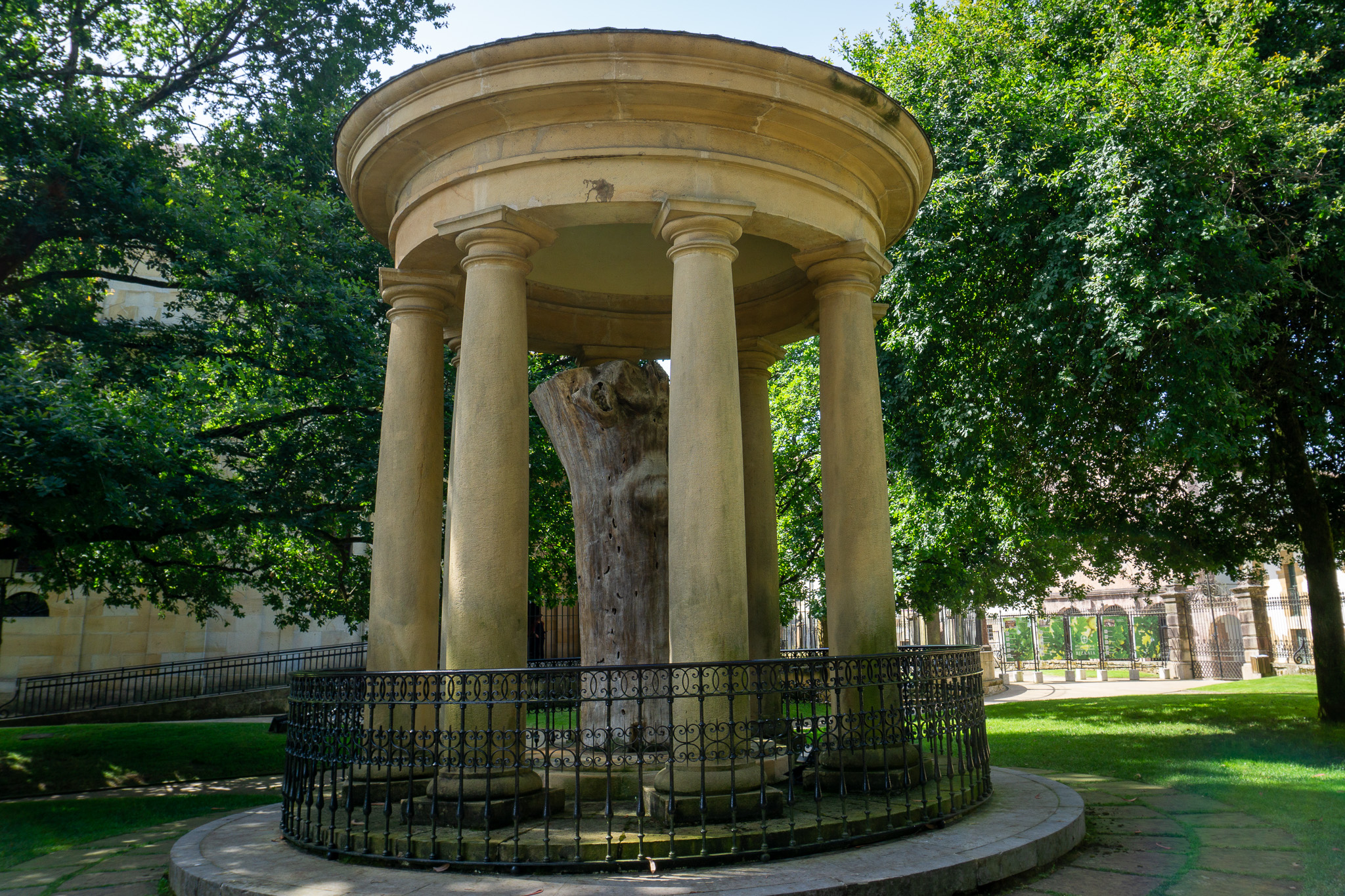
The tree stump circled by pillars pictured above, the Gernikako Arbola held symbolic meaning for people in the region long before the bombing, and now stands enshrined as a symbol of the Basque resistance movement, and of Basque sovereignty.
Thoroughly convinced I had spent enough time wandering around the city and enjoying a break from hiking, I continued on to finish my last quiet day before Bilbao.
Arriving at the Albergue in Eskerrika
After hiking through the midday heat, I decided to treat myself to an early finish, and stopped around 4 p.m. My tired feet had had enough, and I was within a day’s walk to Bilbao.
I was the first pilgrim to arrive to a little albergue run by a friendly gentleman in an old, converted, Basque farmhouse. The farmhouse had a cool aesthetic, but it was a little creepy at first when there were just a handful of people there. I was used to showing up last to the albergues, typically snagging one of the last available beds. The place was decorated with old school motorcycle memorabilia (early Harley, Triumph, and Bultaco accessories) and once I had made myself comfortable it was actually a very cozy place.
After hanging my hand-washed clothes up to dry, I chatted with the owner for a while about the albergue, how busy it had been over the last few years, and about some of the old motorcycles he had owned in the past.


I basically had the whole dorm to myself and at night washing my clothes by hand I took in the scenery and nearly silent surrounding farmland.
I took in the sunset and made my way up to sleep in the nearly empty dorm room for the evening, with only one other person sleeping in the dorm full of empty bunk beds. The owner liked to keep men and women in separate dorm rooms, which meant that it was just me and one other gentleman sleeping in the large room.

Final thoughts
Overall, this was a pretty low energy day, mostly due to the rising temperatures and the very long days I had put in after San Sebastián. Even though I had done some hiking with a weighted pack, one thing that I wasn’t fully prepared for was the consistent slog of walking eight plus hours each day. The section of the Camino del Norte between San Sebastián and Bilbao is the steepest part of the Camino, with the most elevation change of any of the Camino routes.
I saw a few historically monuments, explored some quaint villages, and enjoyed a few conversations with fellow pilgrims. Knowing that I only had one day’s walk to Bilbao was also exciting, because I had reached out to an old teacher friend, who said I could crash on his couch. Looking forward to both catching up with him and taking a rest day in Bilbao, I went to bed in high spirits.
For more posts on planning a Camino de Santiago trek of your own, you can find a feed with all Camino related posts here.
Have you done this section of the Camino? Let me know down in the comments if you think I missed anything. I’ve linked a few Wikipedia pages down below in case you want to read more about the bombing of Guernica, or the history of the famous work of art. And as always, ¡Buen Camino!
Further reading:
Subscribe
Enter your email below to receive updates on the latest posts!
Leave a Reply