
Güemes to Santander
Distance covered: 12.5 miles / 20 km
This leg of the Camino follows roads from the small, rural town of Güemes along a coast dotted with beaches before finally reaching the capital city of Cantabria, Santander. Santander is another great place to book an extra night in a hostel or hotel, offering plenty of historic sites to see, gorgeous beaches, and a vibrant food scene.
The day started out with a pleasant breakfast at the albergue in Güemes, passed by some beautiful coves, and ended with a ferry ride into the city. Though Santander isn’t a major city by global standards, it is the birthplace of the major bank Banco Santander and is the largest city in the autonomous community of Cantabria.
If this is your first Camino post, check out the main Camino page to see every post in order starting from the French border. And in case you have questions about the Camino itself, check out my post covering some of the Camino basics.
Breakfast at the albergue in Güemes
Most of the pilgrims in my room were up by six thirty, and breakfast was held in the main dining area at seven. There was plenty of coffee and several types of jam to put on the tostadas, a typical Camino breakfast. I sat and chatted with the other pilgrims at my table about the different routes everyone was planning to take that day. Since most of the country roads eventually funneled into the same port, there were several possible options: some longer and more scenic, and others more direct but less interesting.
My general plan was to head out towards the coast and then follow the coastline down to Somo where I would catch the ferry over to Santander. After saying goodbye to the pilgrims I was eating with, I headed back down the road towards the marked Camino path.

Heading from Güemes out to the coast


I set out around eight, and the morning was calm and quiet, following paved country roads past several farms. I headed up towards the coast and only saw a few cars out on the roads. I walked past plenty of dairy farms, and trust me, you could smell the cows before you could see them.
It was pretty hard to get lost since there was really only one major road for much of the way, and the familiar yellow arrows were painted onto the backs of signs or onto walls where mistakes were possible.


Omens of good luck in Langre
Having just thoroughly washed and even dried (a luxury in Spain) all of my clothes, I was feeling pretty good. Just a few hours into my morning, a large seagull flew directly overhead and dropped a turd squarely onto my shirt and my backpack. Many people in Spain would say that this was an omen of good luck, but at the time it didn’t feel particularly lucky.
I poured some water on it, scraped off what I could with a leaf, and carried on. Maybe it was a sign reminding me not to expect to get too clean on this hike? At any rate, my shirt did not stay clean for very long.


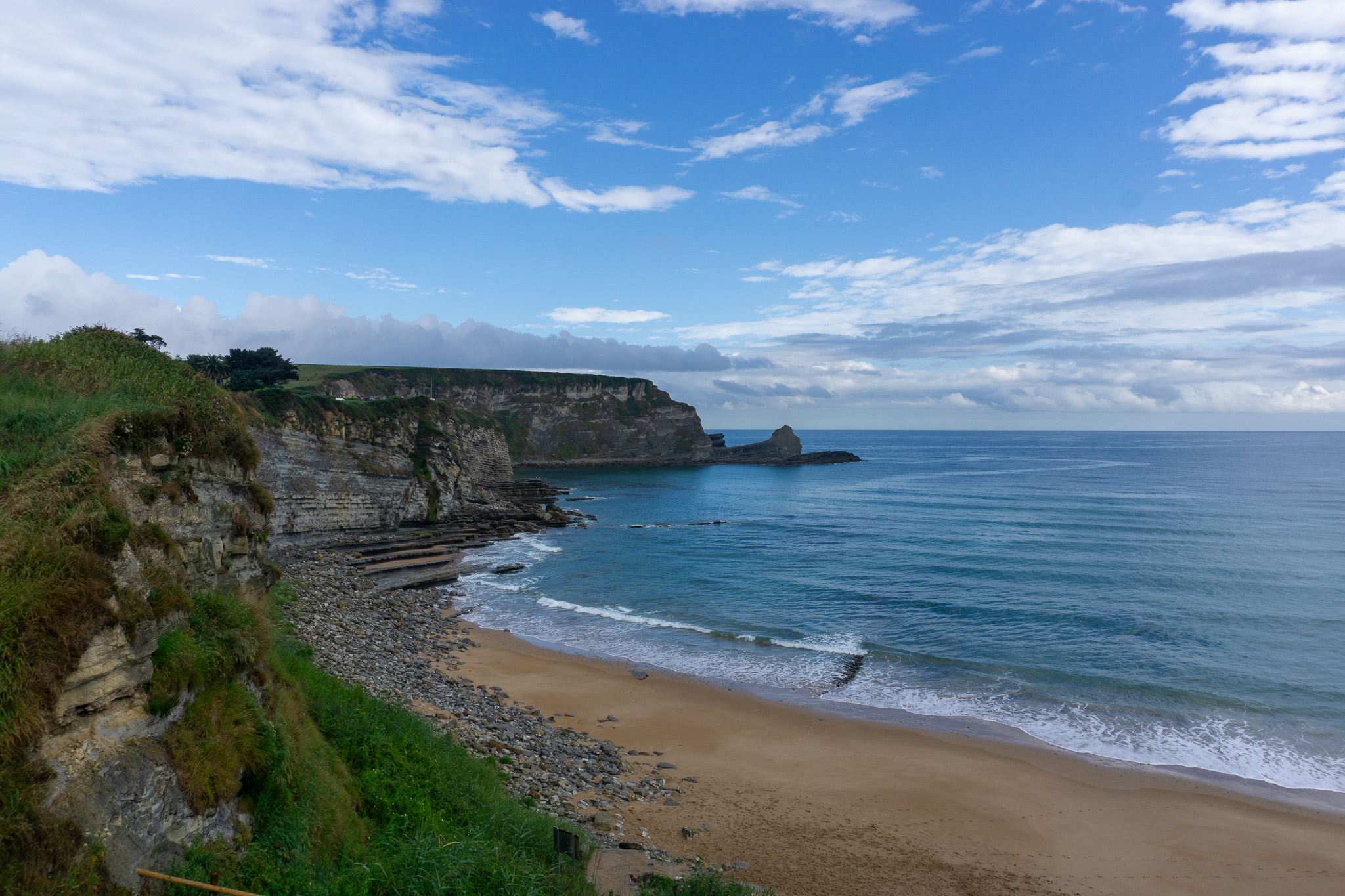
I eventually made it to Playa de Langre, a beautiful beach with high rocky cliffs on either side. I took my pack off and enjoyed a little snack break and took a few photos. To be honest, I would have loved to stay and wade in the water, but I didn’t want to arrive in the city too late and be left scrambling trying to find accommodations.
As I enjoyed the view, a cyclist stopped by, and we chatted a bit about biking the Camino. As I have mentioned before, some pilgrims choose to do the Camino on bike or even on horseback. While covering extra miles each day makes for an interesting option, it is a little complicated for foreigners to fly a bike into the country. It’s not impossible (some airlines will check bike boxes as oversized luggage), but definitely not as easy as just traveling with a single carry-on bag. There are also slightly different rules if you want to get your Credencial, the official document of completion, on a bike versus on foot. I go into more detail on this in my general Camino de Santiago post if you want to check it out there.


If you do decide to take the coastal route, you should know that there are very few places to go to the bathroom, so plan accordingly. The coastal route is beautiful, but it’s mostly along farm roads without many stores or cafés.


The rest of the hike featured a mixture of coastal paths and country roads between farms and small clusters of houses.
Ferry to Santander
For just a few euros, the ferry will shuttle you across the Bahia de Santander, providing great views of the city on clear days. As I waited for the ferry at the port in Somo, I struck up a conversation with several cyclists from the UK. They were all recently retired and riding a large section across the north of Spain and making use of the albergue system.


While many pilgrims do complete the whole route to Galicia, it’s also common to choose small sections to complete as well. Due to time constraints, many people complete the Camino in sections over months or even years, depending on their situations. Obviously, flying all the way from the US can be quite expensive, so I was committed to finishing the entire pilgrimage in one go.

I made my way out of the port and into the heart of downtown to find the public albergue, which was in a decent location but was in rough condition.
Albergue público in Santander
I found the public albergue after exploring around town a bit and was a little disheartened. The bathroom there was filled with black mold and was the worst bathroom I saw throughout my whole hike. A few weeks after staying here, I met some pilgrims from the US who had stayed in the same place, and he mentioned that he didn’t even take a shower the day he stayed there. I took a quick one because I was too gross not to clean off after the long, hot day of hiking, but was in and out as quickly as possible.
After washing off and claiming a bunk, I spent some time in my room removing some footage off of the GoPro that I had brought with me to document the experience. A German pilgrim had invited me out for dinner with her, but I had to decline because I was still trying to transfer the data to my tablet. In hindsight, I probably would have left that at home because I really did not use it much and it was an unnecessary extra weight.
Once I had finally finished the data transfer, I went out to the nearest supermarket and got some food for my dinner and snacks for the next day. Though the albergue bathrooms were gross, this was a cheap night on the Camino with easily accessible supermarkets and an inexpensive place to sleep. While I ate, I caught up with a friend in Berlin who was one of my roommates during my time living in San Sebastián.
Route details
For a detailed route description, take a look at the map on Gronze.com. On that website there is a route map and a comprehensive list of the places to stay along this section with rough price guides. The red and green bars signify the distance from the Camino route, each with a rough distance estimate.
The private albergues and hotels allow for booking ahead of time, while the donation-based albergues (marked with a D for donativo) are all first come, first served. The amenities are basic, but it’s by far the most affordable way to walk a Camino.
If you’re interested in reading the detailed route description, you’ll have to translate the page from Spanish to English, which you can do using the three vertical dots in the upper right.
Final thoughts
This was an average day of walking with minimal elevation change and a lot of paved sections, but with some great coastal views if you took the time to veer a bit off the main trail. The pathfinding was simple enough, and the views were well worth it.
I definitely wouldn’t recommend the public albergue in Santander, or at least not the one that I stayed at. While the price for a bunk was inexpensive, the moldy showers were less than ideal. Hopefully they have addressed that issue since I was there, but maybe look into a few other options just in case. That said, there are plenty of private albergues or hostels around that only charge a few euros more for a bunk. I’d recommend splurging in this city if you can afford it. Overall, this quiet day of hiking included a scenic ferry ride, some beautiful coastline, and quiet walking down well-marked country roads.
Let me know down in the comments if you have hiked this section and if you know of any quality alternative albergues in the city. And as always, ¡Buen Camino!
Subscribe!
Enter your email below to receive updates on the latest posts
Leave a Reply